
Blog
It is 9:30 PM on a weekday evening. Dinner is winding down, street sounds drift in from outside, and at the study desk, a middle or high schooler sits hunched under a lamp. Spread across the desk is a towering stack of notebooks: dense science chapters, heavy math problem sets, history timelines, and language readers.
In hand is a bright neon highlighter. Nearly half the page is glowing yellow. The chapter has been read three times over. To any parent peeking into the room, everything looks on track. Yet if you ask that same student to close the book and explain the core mechanism of what they just read, silence takes over.
This quiet panic surfaces repeatedly as unit tests, term exams, and pre-boards draw near. With rigorous syllabi covering a wide spectrum of subjects simultaneously, students cannot rely on passive recognition. Re-reading pages until they blur does not build genuine exam readiness. Two cognitive strategies—Active Recall and Spaced Repetition—fundamentally change how knowledge sticks.
The "Illusion of Competence": Why Re-Reading Fails Us
When someone reads a chapter multiple times, the sentences, diagrams, and headings begin to look familiar. The reading feels fluid and effortless, tricking the brain into an Illusion of Competence—the feeling that because information is easily recognized, it is also thoroughly understood.
Recognition is entirely different from retrieval. Skimming a derivation and thinking “Right, that makes sense” is nothing like staring at a blank answer sheet when there are no hints or clues available.
Passive reading is like watching someone run drills and expecting your own stamina to improve. Active Recall, by contrast, is the actual mental exertion. It forces the brain to search its neural pathways and reconstruct concepts without looking at the page. That moment of friction—pausing and wrestling with “What were the exact causes of this event?” or “What is the second step of this formula?”—is where long-term memory takes root. Every time the mind retrieves an idea with effort, that pathway becomes stronger and faster to access.
The Forgetting Curve: Why Last-Minute Cramming Disappears
In the late 19th century, psychologist Hermann Ebbinghaus mapped the Ebbinghaus Forgetting Curve. His research revealed that within 48 hours of absorbing new material, the human brain forgets up to 70% of it unless the information is revisited intentionally.
During busy exam seasons, marathon cram sessions are common. Students pull late nights, push through on sheer willpower, write the paper the next morning, and secure passing or even decent marks. Yet a few weeks later, when the comprehensive exams arrive, that knowledge has vanished. Cramming provides quick short-term recall, but it resets the forgetting curve back to zero every single time.
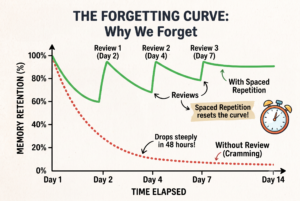
Spaced Repetition directly interrupts this decline. Instead of revising a single topic for four unbroken hours over the weekend, the material is reviewed in short, deliberate intervals:
Review 1: 24 hours after the classroom lesson
Review 2: 3 days later
Review 3: 7 days later
Review 4: 21 days later
Each review interval halts the curve’s decay, resetting retention back to near 100% and gradually flattening the slope. This shifts facts, concepts, and formulas from vulnerable short-term working memory into permanent long-term storage.
Three Practical, Screen-Free Methods That Fit Everyday Routines
Adopting these techniques does not require specialized apps or complex software. Straightforward, tactile habits work exceptionally well alongside standard school routines.
1. The Blurting Method (For Dense Theory and Concepts)
- Read one sub-topic or concept thoroughly (such as transpiration in plants or a specific historical act).
- Shut the textbook completely and slide it out of sight.
- Take a plain rough notebook and write out every single detail remembered—diagrams, definitions, dates, and flowcharts—without referencing the text.
- Reopen the chapter. Take a contrasting red or blue pen and mark down whatever was missed or misstated.
- Those marked gaps become the sole focus for the next quick revision session, saving precious study time compared to re-reading all twenty pages.
2. The 3-Box Leitner Flashcard Box (For Formulas, Terms, and Dates)
Cut up spare card stock or index sheets into pocket-sized cards. Place three small, labeled boxes or envelopes on the desk: Box 1 (Daily), Box 2 (Every 3 Days), and Box 3 (Once a Week).
- Write a question or prompt on the front of each card (“Define Lenz’s Law” or “Give the three conditions for seed germination”).
- Write the concise explanation or formula on the back.
- Every card starts in Box 1. When tested, a correct answer moves the card to Box 2; an incorrect answer keeps it in (or demotes it back to) Box 1.
- This system ensures difficult equations and tricky vocabulary receive daily practice, while concepts already mastered aren’t wasting daily revision bandwidth.
3. Commute Quizzing
The time spent sitting in traffic, waiting for the school bus, or walking home is an ideal window for self-quizzing. Challenge yourself mentally: “Can I explain Newton’s laws with real-world examples step-by-step right now without checking my notes?” If the explanation stalls halfway through, you know precisely which section to revisit during evening study hours.
Redefining Productive Study: Retrieval Over Hours
Academic success is often mistakenly judged by the clock: “They sat at their desk for five hours straight.” But if several of those hours were spent staring at pages while attention wandered, the retention return is minimal.
Real academic readiness is not about the number of hours an open book sits in front of a student. It is about how clearly, calmly, and accurately the brain retrieves knowledge when the books are closed, the desk is clear, and the question paper is turned over.
By replacing passive rereading with active recall exercises and trading midnight cramming for strategic review intervals, students build authentic understanding. The syllabus feels manageable, exam anxiety diminishes, and study hours lead to true long-term mastery.